The Queensland Bird
Research and Banding Group is a special-interest
group within Birds Qld.
The Queensland Bird Research and Banding Group (the Group) is a citizen science Special Interest Group within Birds Queensland.
As qualified bird banders the Group is focused on furthering the scientific study and knowledge of the birds of Queensland and adjacent areas using bird banding and emerging technologies like satellite tracking.
In partnership with Governments, universities and other Non-Government Organisations the Groups research focus includes shorebirds, terrestrial birds and water birds.
The Group also facilitates involvement in the scientific study of birds through an education program that trains skilled and ethical bird banders and assists banders to publish their studies in peer reviewed scientific journals. Members also receive an annual Bird Banding report, which is summarised in The Sunbird each year.
To contact the Group or enquire about bird banding and/or membership please email: qbrbgcorrespondence@gmail.com
Project spotlight – Eungella Honeyeater
The Eungella Honeyeater is Central Queensland’s only endemic bird species, and it is now listed as Vulnerable by the State Government. Despite concerns for the species, it is poorly understood and remains a bit of a mystery. Some observations suggest it is an altitudinal migrant spending most of the summer months in the higher altitudes of the Clarke Range with at least some birds moving down to the lowlands during winter. Perhaps this is simply following food sources during the seasons. However, nobody knows for sure as no one has been able to track them through the seasons. Knowing how to protect the Eungella Honeyeater relies first and foremost on knowing where it lives, and when it is there!
In an effort to find out what these birds are up to, the Queensland Bird Research and Banding Group have been colour banding Eungella Honeyeaters at a number of locations from Dalrymple Heights to Crediton and in Finch Hatton Gorge, in the hopes that people will see and photograph them when they turn up in different locations. Colour banding uses a unique combination of colours to identify the location the bird was first caught. The bird will have a metal band closest to the foot with a colour band above it on one leg, with the other leg having two colours, one above the other. Every combination of colours is different allowing us to identify the exact individual without the need for recapture.
If you see a bird with colour bands we would like to know about it. Ideally try to take a photo of the legs, or note the combination of the colours (e.g. Right leg- blue band over metal, Left leg- green band over red band). By engaging more observers and photographers we may be able to unlock some of the mysteries and gain a better understanding of this enigmatic bird!
Have you seen or photographed a Eungella Honeyeater with colour bands while birding west of Mackay? Let us know! Please contact the Queensland Bird Research and Banding Group at qbrbgcorrespondence@gmail.com to report your sighting.
Every credible resighting of a colour banded bird will be personally replied to with details of its known history including where it was originally banded.


Migratory shorebirds:
In partnership with the Queensland Wader Study Group (QWSG) and university researchers the Group catches, measures and tag’s shorebirds with individual metal bands, engraved coloured leg flags, satellite and GPS trackers.
This enables shorebird populations to be monitored and individuals to be tracked in Queensland and overseas in the Pacific Flyway, helping to identify key shorebird habitats and behaviours.
For example, satellite tracking data from endangered Far Eastern Curlews (Numenius madagascariensis) fitted with satellite trackers under a QWSG project have provided new insights into how the species navigates, their migratory routes and home ranges.
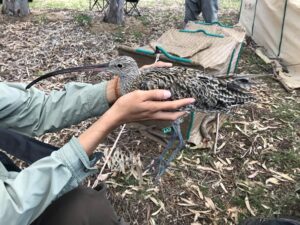
The Far Eastern Curlew AAD being fitted with a satellite tracker, metal band and engraved leg flag (R. Bush).
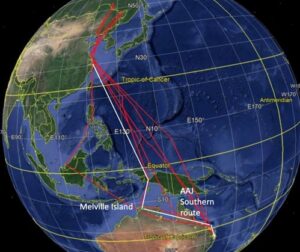
Satellite data showing the movements of Far Eastern Curlew AAJ, one of the Far Eastern Curlew tracked by the QWSG.
Recent shorebird publications involving the QWSG and QBRBG include:
- Galtbalt, B., A. Lilleyman, J. T. Coleman, C. Cheng, Z. Ma, D. I. Rogers, B.K. Woodworth, R. A. Fuller, S.T. Garnett and M. Klaasen. 2021. Far Eastern Curlew and Whimbrel prefer flying low – wind support and good visibility appear only secondary factors in determining migratory flight altitude. Movement Ecology. 9(1): 32. doi: 10.1186/s40462-021-00267-5
- Coleman J.T., S. Macdonald, R. McMillan. Survival, Movements and Breeding Success of Bush Stone-curlews Burhinus grallarius in the Moreton Bay region, Queensland. The Sunbird 49(1): 48-61.
- Morrick Z.N., A. Lilleyman, R.A. Fuller, R. Bush, J. T. Coleman, S.T. Garnett, Y. N. Gerasimov, R. Jessop, Z. Ma, G. Maglio, C.D.T. Minton, E. Syroechkovskiy, and B. K. Woodworth. 2021. Differential population trends align with migratory connectivity in an endangered shorebird. Conservation Science and Practice. doi:10.1111/csp2.594
Terrestrial birds.
The group catches, measures, weighs and bands terrestrial birds across a range of land tenures and habitats throughout Queensland and northern New South Wales.
Many of the birds caught by the QBRBG are poorly studied with a key outcome of this research being to document basic species characteristics, survivorship, movement and how to identify the age and gender of terrestrial birds.
The data produced by these projects also enables the monitoring of population trends across a range of different terrestrial bird groups and habitats.
The group also partners with university researchers and governments to tag larger birds with satellite trackers and to take samples like blood and faeces for genetic and bird health studies.
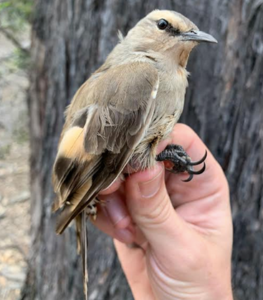
A Brown Treecreeper (Climacteris picumnus) sampled as part of a PhD project on Australian Treecreeper genetics that the QBRBG assisted with (B. Doohan).
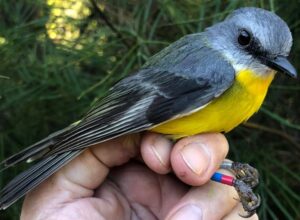
Eastern Yellow Robin (Eopsaltria australis) colour banded as part of a project investigating their home ranges (J. Coleman).
Recent terrestrial bird publications involving the QBRBG include:
- Bean A. J., Braithwaite D. S., Braithwaite R. and J. T. Coleman. 2021. Food Plants of the Eungella Honeyeater (Bolemoreus hindwoodi). North Queensland Naturalist 51: 30-37.
- Coleman J. 2019. Monitoring long term trends in common Australian birds across a range of habitats in Queensland. Sunbird 48: 136-143.
- Coleman J.T., R. A. Noske, B. Smith and Y. A. Mulyani. 2019. Moult timing and morphometrics of Mangrove Gerygones: a comparison of monsoon-tropical and subtropical populations. Corella 43: 106-113
- Coleman J.T. and P. Lloyd. 2017. Using sexual dimorphism in morphometric traits to sex Eastern Yellow Robins (Eopsaltria australis). Corella 41: 15-19
- Coleman J.T. and R. A. Noske. 2017. Mangrove Gerygones (Gerygone levigaster) are short-lived compared to other small Australian passerines. Corella 41:1-7
Waterbirds
The Groups waterbird research focuses on banding and measuring Black Swans (Cygnus atratus) to investigate their reproductive success, survivorship, movement and population trends in Queensland.
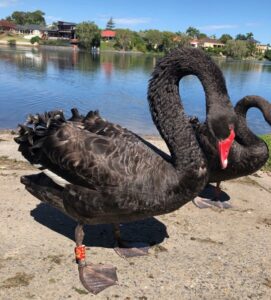
Black Swan ASF fitted with metal leg band and engraved leg darvic (J. Coleman).
Recent waterbird publications involving the QBRBG include:
- Coleman, J.T., D.S. Braithwaite, and L.A. Coleman. 2021. Sexual size dimorphism in the black swan and an alternative to cloacal sexing. Corella 45:1-6
- Coleman J. 2019 Breeding Biology of Black Swans. Sunbird 48: 127-129.
- Eileen C. Rees, Lei Cao, Preben Clausen, Jonathan T. Coleman, John Cornely, Olafur Einarsson, Craig R. Ely, Richard T. Kingsford, Ming Ma, Carl D. Mitchell, Szabolcs Nagy, Tetsuo Shimada, Jeffrey Snyder, Diana V. Solovyeva, Wim Tijsen, Yerko A. Vilina, Radosław Włodarczyk, and Kane Brides. 2019. Conservation status of the world’s swan populations, Cygnus sp. and Coscoroba sp.: a review of current trends and gaps in knowledge. Wildfowl Special Issue 5: 35–72